Anna-Lülja Praun
Architect and designer
„I didn’t ask myself whether it was possible for a woman or not. I wanted to do something – and no one stopped me.“
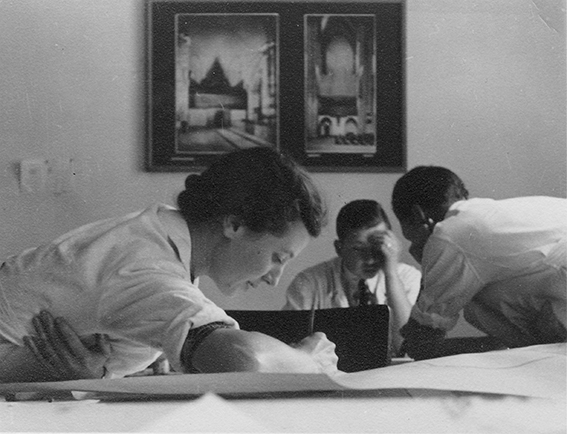
Anna-Lülja Simidoff was born in Saint Petersburg to a Russian doctor and a Bulgarian lawyer and publisher. She grew up multilingual in a liberal and cosmopolitan environment in Sofia. Due to the good relations Austria maintained with Bulgaria in the 1920s, she decided to go to Graz in 1924 to study architecture at the Technical University (today’s Graz University of Technology). This made her, along with Margarete Schütte-Lihotzky, one of the first women in Austria to study architecture.
While still a student, she worked in the studio of Styrian architect Herbert Eichholzer, and from 1937 onwards with Clemens Holzmeister in Vienna. She was connected to Eichholzer, who was politically left-wing and a supporter of the international avant-garde, not only through work but also through a relationship that lasted until 1937. He was murdered by the Nazis in 1943 as a member of the resistance. Ms. Simidoff was also arrested under the Nazi regime in 1938 but was later released. She spent the first years of the war in France and Bulgaria. In 1942, she returned to Vienna, where she married architect Richard Praun. Their daughter Svila was born that same year. In the following years, she worked together with her husband.
After separating from him, she opened her own studio in Vienna in 1952. She designed houses, interiors, shops, furniture, lighting fixtures and, together with Gudrun Baudisch, ceramics. From 1953 to 1959, she ran the furniture store Haus und Garten (House and Garden), founded in 1925 by Josef Frank and Oskar Wlach, together with Leo Calice-Kalmar. Her designs are characterised by appropriate use of materials, the highest quality workmanship and a stringent design approach. Oliver Elser wrote in his 2004 obituary, “Anna-Lülja Praun never designed furniture for mass production.” In 1981, she was honoured with the City of Vienna Prize for Applied Arts.