Grazer Damen-Bicycle-Club
Cycling toward freedom
„The bicycle has contributed more to the emancipation of women from the upper classes than all the efforts of the women’s movement combined.“ (Rosa Mayreder, 1905)
While cycling is now an integral part of everyday life, at the end of the 19th century it was still considered an eccentric pastime. Considered by men to be a meaningless pastime of the upper classes, it seemed almost unthinkable that women would get on a bicycle. Doubts about their physical constitution and stamina went hand in hand with the common belief that they should stay at home and look after the family rather than moving freely in public spaces – and on a bicycle of all things. There was also a fear that a flushed appearance from exertion and fluttering skirts would be contrary to feminine grace. This slowly changed with the founding of the Ladies’ Bicycle Club in Graz in 1893.
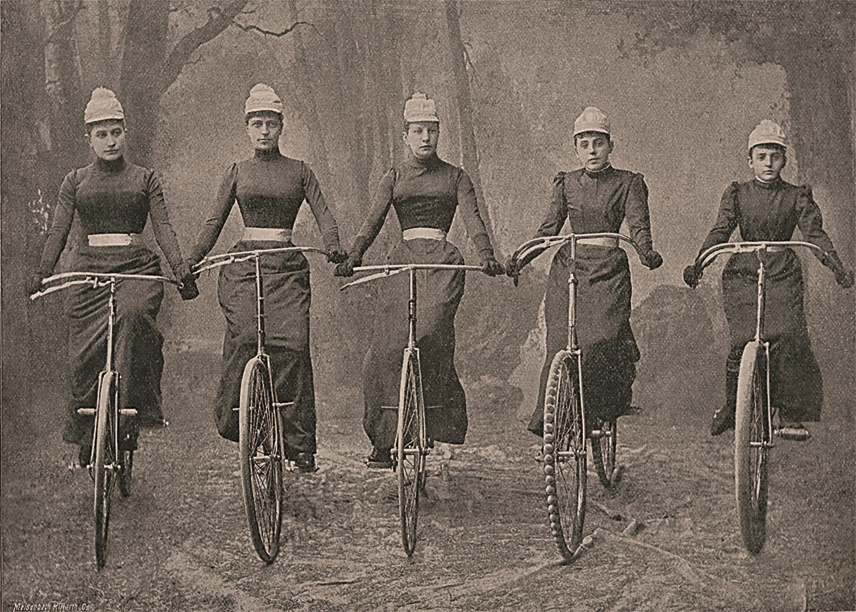
The central figure in local women’s cycling was Elisabeth Steininger (née Rauch), who became involved through her husband Carl Anton Steininger, a founding member of the Graz Touring Cyclists. She learned to ride a bicycle at the age of 37 in 1891 and was hooked from then on. During a “joyful bike ride from Bruck to Graz” in the autumn of 1892, she and Vincenza Wenderich, a native of Dalmatia, hatched a plan to found their own cycling club for women: The idea for the Graz Ladies’ Bicycle Club was born. The association was officially founded on 16 February 1893, but its future founders made their first public appearance on 7 December 1892. To mark the 10th anniversary of the Graz Bicycle Club, which was made up of solid middle-class members, Steininger and Wenderich, together with Louise Sorg and Mitzi and Louise Albl, performed a bicycle dance, during which this photo was taken.
The cycling trips organised by the Ladies’ Bicycle Club, which took participants to the surrounding area of Graz, were particularly popular. In addition, the cyclists also took part in parade rides, which they used to promote their hobby and, in the process, gain more space for women to exercise.