Ruth Feldgrill-Zankel
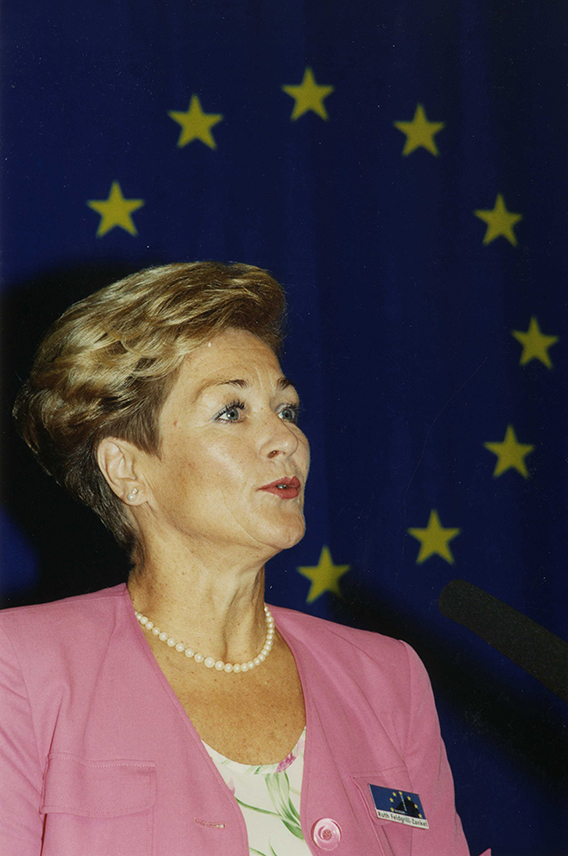
With commitment and openness for Graz
„It is not so much women who need politics, but politics that needs women, because otherwise the larger half of the world is only cared for, but does not have the opportunity to help shape its concerns. “
Ruth Feldgrill-Zankel initially worked as a journalist for the Graz-based daily newspaper Südost-Tagespost (1968–70) and as a press officer for the Austrian People’s Party’s regional party leadership in Styria (1970–74) before she began to establish the Grazer Rathauskorrespondenz (press office of Graz City Hall), which she headed until the mid-1980s. Her constant interest in politics, combined with her desire not only to comment on political decisions but also to help shape them and take responsibility for them, ultimately led her to the city government.
In her role as city councillor, to which she was elected in 1987, Ruth Feldgrill-Zankel was keen from the outset to establish the presence of women in political office as something natural. A first step in this direction was the introduction of the title Stadträtin (gendered form of Stadtrat, i.e. city councillor in German), which did not exist at that time. In line with her conviction that language use determines our perception of the world, it was Feldgrill-Zankel who made it possible for the feminine form of city councillor to become established in everyday political life.
In 1991, she moved into federal politics and served as Austrian Federal Minister for the Environment, Youth and Family Affairs for two years, a role in which she participated in the major environmental conference in Rio de Janeiro and its follow-up conference at the UN in New York City, where she addressed the plenary session. In 1992, she returned to Graz as deputy mayor, becoming the first woman to hold this office. Whether dealing with questions about infrastructure, environmental issues or tourism statistics, Ms. Feldgrill-Zankel gained a thorough understanding of the topics through exchange with universities and research institutes, enabling her to identify both weaknesses and strengths and derive systematic strategies for action.
By promoting the acquisition of EU projects, urban and economic development issues, the outsourcing of the tourism department and a generally more efficient use of tourism potential – including the revitalisation of the Schlossberg – Ms. Feldgrill-Zankel succeeded in raising the profile of Graz both nationally and internationally. With this in mind, she also advocated for an EU ministerial meeting to be held in Graz for the first time, where this photo was taken. In 2002, she was awarded the Grand Decoration of Honour of the State of Styria for her services.