Susanne Wenger (Adunni Olurisa)
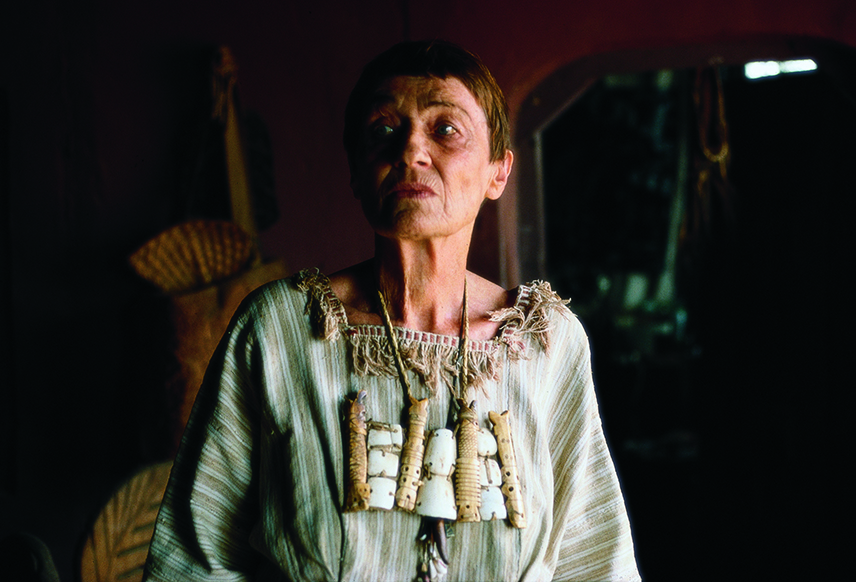
Artist between cultures
„Art is ritual, or it is not art.“
Susanne Wenger, daughter of Swiss-Austrian parents, attended the School of Applied Arts in Graz and the Federal Teaching and Research Institute for Graphic Arts in Vienna, then studied painting at the Academy of Fine Arts in Vienna with Arnold Boeckl, among others. After the National Socialists came to power, she hid her Jewish partner and became involved in resistance circles. She was forced into internal exile as an artist until the end of the Nazi era.
From 1946 onwards, Ms. Wenger worked for the communist children’s magazine Unsere Zeitung (Our Newspaper) and published articles in the art magazine Plan, edited by Otto Basil. In 1947, she co-founded the Vienna Art Club, a meeting place for representatives of modern art. After spending time in Italy and Switzerland, she moved to Paris in 1949, where she met her future husband, the linguist Ulli Beier. In 1950, the couple emigrated to Nigeria, where Ms. Wenger fell seriously ill with tuberculosis. No doctor, only a Yoruba traditional healer, could help her.
Susanne Wenger then turned to the Yoruba religion, made Nigeria her adopted home and later became a Yoruba priestess. She was the founder of the archaic-modern art school New Sacred Art and guardian of the Sacred Grove of the Goddess Osun on the banks of the Osun River in Oshogbo (Nigeria). The sculptures she created there in the late 1950s together with local artists have been a UNESCO World Heritage Site since 2005. In 2009, Susanne Wenger passed away in Oshogbo at the age of 94. Since 2011, the Susanne Wenger Foundation in Krems has been working to preserve the artist’s legacy, which consists of her art and her philosophy of life.